
No batter has ever scored a triple century in men’s or women’s One Day International (ODI) cricket. The highest individual score in men’s ODI cricket is 264 runs by Rohit Sharma, who achieved the record against Sri Lanka at Eden Gardens, Kolkata, on 13 November 2014. In women’s ODI cricket, New Zealand’s Amelia Kerr holds the record with an unbeaten 232 against Ireland on 13 June 2018.
A triple century means scoring 300 runs in a single innings. Although ODI cricket allows each team to face a maximum of 50 overs, no batter has reached this milestone in international one-day cricket. Rohit Sharma’s 264 remains the highest individual score in men’s ODIs, while Amelia Kerr’s 232 is the corresponding women’s record.
Has Anyone Scored a Triple Century in ODI Cricket?
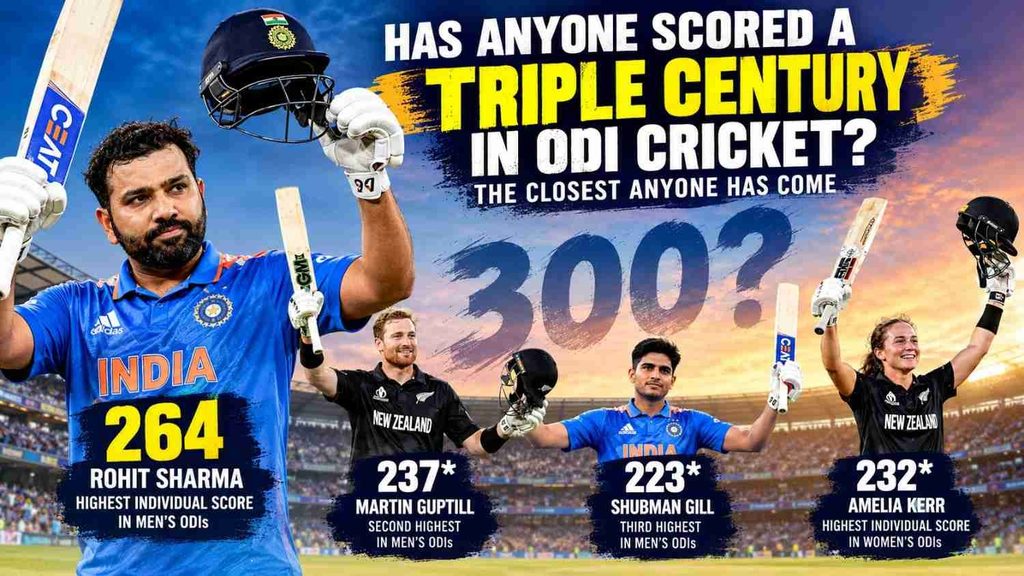
No. As of 30 October 2026, no player has scored 300 runs in a single innings in either men’s or women’s ODI cricket.
Rohit Sharma holds the men’s ODI record with 264 runs against Sri Lanka in 2014. He scored 33 fours and nine sixes from 173 balls, helping India post 404/5 and win the match by 153 runs.
New Zealand’s Martin Guptill ranks second with an unbeaten 237 against the West Indies in the 2015 Cricket World Cup quarter-final. India’s Shubman Gill is third following his unbeaten 223 against the West Indies in Guwahati on 30 September 2026. Gill’s innings helped India chase 406 and win by eight wickets.
These performances demonstrate how far batters can push the limits of scoring in a 50-over match. However, reaching 300 remains an unbroken record in ODI cricket.
What Is the Highest Individual Score in ODI Cricket?
Rohit Sharma holds the highest individual score in men’s ODI cricket with 264 runs against Sri Lanka at Eden Gardens, Kolkata. His innings remains the benchmark for individual batting performances in the format.
The following table lists the highest individual scores in men’s ODI cricket, ranked by runs scored. Equal scores share the same rank, and the next rank is skipped.
| Rank | Player | Team | Score | Opponent | Venue | Date |
| 1 | Rohit Sharma | India | 264 | Sri Lanka | Eden Gardens, Kolkata | 13 November 2014 |
| 2 | Martin Guptill | New Zealand | 237* | West Indies | Westpac Stadium, Wellington | 21 March 2015 |
| 3 | Shubman Gill | India | 223* | West Indies | ACA Stadium, Guwahati | 30 September 2026 |
| 4 | Virender Sehwag | India | 219 | West Indies | Holkar Stadium, Indore | 8 December 2011 |
| 5 | Chris Gayle | West Indies | 215 | Zimbabwe | Manuka Oval, Canberra | 24 February 2015 |
| 6 | Fakhar Zaman | Pakistan | 210* | Zimbabwe | Queens Sports Club, Bulawayo | 20 July 2018 |
| 6 | Pathum Nissanka | Sri Lanka | 210* | Afghanistan | Pallekele International Cricket Stadium | 9 February 2024 |
| 6 | Ishan Kishan | India | 210 | Bangladesh | Zahur Ahmed Chowdhury Stadium, Chattogram | 10 December 2022 |
| 9 | Rohit Sharma | India | 209 | Australia | M. Chinnaswamy Stadium, Bengaluru | 2 November 2013 |
| 10 | Rohit Sharma | India | 208* | Sri Lanka | PCA IS Bindra Stadium, Mohali | 13 December 2017 |
| 10 | Shubman Gill | India | 208 | New Zealand | Rajiv Gandhi International Stadium, Hyderabad | 18 January 2023 |
An asterisk (*) indicates that the batter remained not out. Equal scores share the same rank, and the next position is skipped. The table contains 11 innings across the top 10 ranking positions.
Rohit Sharma remains the only batter to have scored three double centuries in men’s ODI cricket. Shubman Gill has scored two, with his 208 against New Zealand in January 2023 and his unbeaten 223 against the West Indies in September 2026.
Rohit Sharma’s 264: The Closest to a Triple Century in ODI Cricket
Rohit Sharma produced his record-breaking innings against Sri Lanka at Eden Gardens, Kolkata, on 13 November 2014. His performance established a new benchmark for individual scoring in men’s ODI cricket.
Match Details
| Match Detail | Record |
| Batter | Rohit Sharma |
| Opponent | Sri Lanka |
| Venue | Eden Gardens, Kolkata |
| Date | 13 November 2014 |
| Runs scored | 264 |
| Balls faced | 173 |
| Fours | 33 |
| Sixes | 9 |
| Strike rate | 152.60 |
| India’s total | 404/5 |
| Result | India won by 153 runs |
Rohit combined patience with aggressive stroke play. He built his innings before accelerating, putting the Sri Lankan bowlers under sustained pressure with an exceptional range of shots.
His start was relatively cautious. He was dropped on four runs by Thisara Perera, and reached his first fifty from 72 balls with only five fours. He then reached 100 from 100 deliveries.
After reaching his century, Rohit accelerated dramatically. In his final 22 deliveries, he struck nine boundaries and three sixes, taking his score to 264.
His 33 fours established a world record for the most fours in a single men’s ODI innings. The match was also part of Eden Gardens’ 150th anniversary celebrations.
Rohit was dismissed off the final ball of India’s innings, caught by Mahela Jayawardene off Nuwan Kulasekara while attempting another big shot.
He finished 36 runs short of a triple century. Sri Lanka were bowled out for 251, 13 runs fewer than Rohit’s individual score, securing India a 153-run victory.
After the innings, Rohit said: “I’m not really tired, I was ready to bat another 50 overs.”
The innings remains one of the most remarkable achievements in international one-day cricket, and no batter has surpassed it as of October 2026.
Who Has Come Closest to 300 Runs in ODI Cricket?
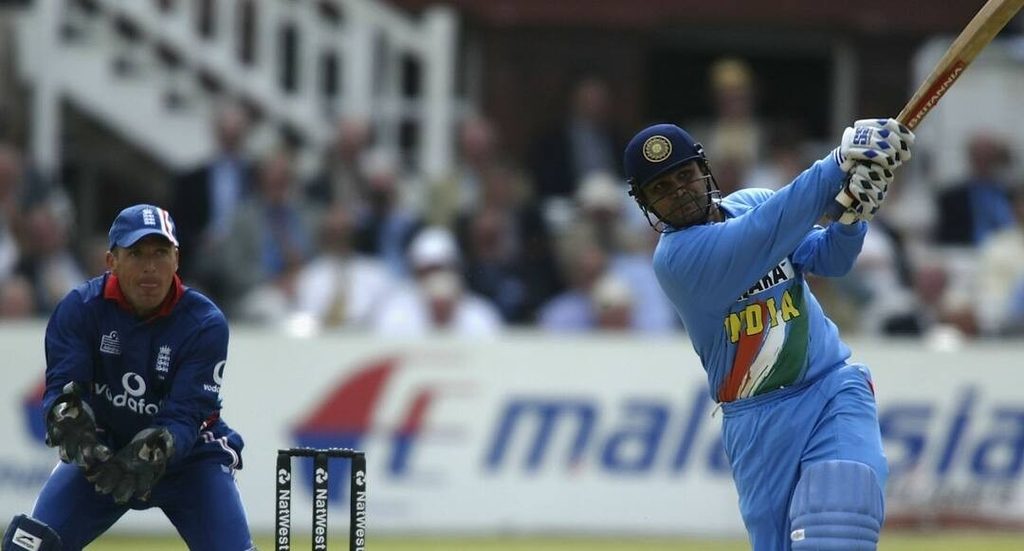
Source Image: ABP Live
Rohit Sharma is the closest batter to a triple century in men’s ODI cricket, with 264 runs. However, the men’s and women’s records are different, so both deserve attention.
1. Rohit Sharma: 264 Runs
Rohit’s innings against Sri Lanka remains the highest individual score in men’s ODI cricket. He reached 264 from 173 balls, hitting 33 fours and nine sixes.
His combination of timing, placement and power allowed him to maintain an outstanding scoring rate throughout a long innings. The performance helped India reach 404/5 and established a record that remains unbeaten.
2. Martin Guptill: 237 Not Out
New Zealand’s Martin Guptill scored 237 not out against the West Indies in the 2015 Cricket World Cup quarter-final on 21 March 2015.
His innings came from 163 balls and featured 24 fours and 11 sixes. Guptill helped New Zealand post 393/6 before the team bowled out the West Indies for 250 to win by 143 runs.
His performance remains one of the most memorable individual innings in Cricket World Cup history and the second-highest score in men’s ODI cricket.
3. Shubman Gill: 223 Not Out
Shubman Gill scored 223 not out against the West Indies in Guwahati on 30 September 2026. He faced 133 balls, hitting 26 fours and eight sixes.
The innings helped India chase the West Indies’ total of 405/7, reaching 406/2 in 43.3 overs to win by eight wickets.
Gill’s score moved him into third place on the all-time men’s ODI individual scoring list, ahead of Virender Sehwag’s 219. His achievement also reinforced the potential for modern batters to produce exceptionally high scores in the format.
4. Amelia Kerr: 232 Not Out in Women’s ODIs
New Zealand’s Amelia Kerr scored an unbeaten 232 against Ireland on 13 June 2018, setting the highest individual score in women’s ODI cricket.
Kerr reached the score from 145 balls, hitting 31 fours and two sixes. She also took five wickets in the match, producing an outstanding all-round performance.
Her innings surpassed the previous women’s ODI record of 229 not out, scored by Australia’s Belinda Clark against Denmark on 16 December 1997.
Clark’s 229 not out was the first double century in ODI cricket, in either men’s or women’s international cricket.
Kerr’s 232 remains the women’s ODI record, while Rohit Sharma’s 264 remains the men’s record. Neither format has yet produced an individual score of 300.
Why Has No Batter Scored a Triple Century in ODI Cricket?
Scoring 300 runs in an ODI requires extraordinary consistency, fitness and scoring power. Several factors make the achievement difficult.
1. The 50-Over Limit
Each team can face a maximum of 50 overs in a standard ODI innings. A batter must score 300 runs within this limited period while also managing the risk of dismissal.
To score 300 from 150 balls faced, a batter would need to average two runs per delivery, equivalent to a strike rate of 200. Sustaining that rate over a long innings is an exceptionally demanding task.
2. The Risk of Losing a Wicket
Aggressive batting increases the chances of scoring boundaries, but it also creates opportunities for bowlers to take wickets. One mistake can end a batter’s innings before the target is reached.
Even a batter who passes 200 must maintain concentration, physical energy and sound decision-making to score another 100 runs.
3. Bowling Strategies Change
When a batter begins dominating, opposing teams adjust their plans. Captains change bowlers, reposition fielders and use variations in pace, length and line to restrict scoring.
These tactical changes make it more difficult for a batter to maintain the same scoring rate throughout an innings.
4. Partnerships and Team Strategy Matter
A batter cannot always control the match situation. Losing partners can force a change in approach, while a strong team total may encourage a batter to take fewer risks.
Even when conditions favour batting, reaching 300 requires a rare combination of opportunity, skill and sustained performance.
5. Maintaining Concentration Over a Long Innings
A batter attempting a triple century must remain focused for a substantial period. Physical fatigue, changing pitch conditions and the pressure of approaching a historic milestone can all influence shot selection.
The challenge is not simply to score quickly, but to maintain a high scoring rate without losing a wicket.
Could Someone Score a Triple Century in ODI Cricket in the Future?
Yes. There is no rule preventing a batter from scoring 300 runs in a single ODI innings.
Modern players have access to advanced training, detailed opposition analysis and a wide range of attacking shots. Batting-friendly pitches, fast outfields and shorter boundaries can also help batters accumulate runs.
Recent performances provide strong evidence that the scoring ceiling continues to rise. On 22 October 2026, England captain Harry Brook scored 202 from 116 balls against Sri Lanka at Rawalpindi.
Brook reached his double century in just 114 deliveries, setting the record for the fastest double century in men’s ODI cricket. England posted 429/4 in 50 overs, with Brook hitting 21 fours and 10 sixes.
His innings surpassed Shubman Gill’s previous fastest double-century record of 117 balls. Brook’s performance demonstrated how quickly a modern batter can accumulate runs in ODI cricket.
Rohit Sharma’s 264, Martin Guptill’s 237 not out, Shubman Gill’s 223 not out and Harry Brook’s 202 demonstrate the extraordinary scoring potential of modern batting. Amelia Kerr’s 232 not out also shows that women’s ODI cricket can produce remarkable individual performances.
Rohit Sharma’s own words after his record-breaking innings remain particularly relevant: “I’m not really tired, I was ready to bat another 50 overs.”
However, reaching 300 requires a batter to sustain a high scoring rate while remaining at the crease for a substantial portion of the innings. The target is possible, but it remains one of cricket’s most difficult individual records to break.
Conclusion
A triple century in ODI cricket remains an unachieved milestone. Rohit Sharma’s 264 against Sri Lanka is the highest individual score in men’s ODI cricket, followed by Martin Guptill’s 237 not out and Shubman Gill’s 223 not out. In women’s ODI cricket, Amelia Kerr’s unbeaten 232 holds the record.
Rohit Sharma remains the only batter to have scored three double centuries in men’s ODIs, while Shubman Gill has recorded two. Harry Brook’s record-breaking 202 in October 2026 further demonstrates the increasing scoring potential of modern ODI cricket.
These achievements illustrate how far individual batting performances have advanced, but the 300-run milestone remains beyond reach.
The attacking nature of modern cricket makes a triple century conceivable, but achieving it will require exceptional skill, stamina and sustained concentration. Until someone reaches that mark, Rohit Sharma’s 264 remains the benchmark for the highest individual score in men’s ODI cricket.
Frequently Asked Questions
No. As of 30 October 2026, no batter has scored a triple century in men’s or women’s ODI cricket. Rohit Sharma holds the men’s record with 264 runs, while Amelia Kerr holds the women’s record with 232 not out.
Rohit Sharma holds the record with 264 runs against Sri Lanka at Eden Gardens in Kolkata on 13 November 2014. He scored the runs from 173 balls, including 33 fours and nine sixes.
Rohit Sharma is the closest in men’s ODI cricket, with 264 runs. Martin Guptill ranks second with 237 not out, followed by Shubman Gill with 223 not out. In women’s ODIs, Amelia Kerr holds the highest score with 232 not out.
No. The highest individual score in women’s ODI cricket is Amelia Kerr’s unbeaten 232 against Ireland on 13 June 2018. She scored the runs from 145 balls and also took five wickets in the match.
Yes. The rules do not prohibit a batter from scoring 300 runs in a single innings. However, no player has achieved this milestone in ODI cricket so far.